Lightweight graphene enhances composites and resins by increasing their strength and durability while also providing environmental benefits.
MARKET OVERVIEW
The composites industry consists of various types of reinforcements, such as carbon fiber, glass fiber and aramid fiber, which are embedded within a matrix material, often a polymer resin, to form a composite structure.
$111 BILLION MARKET SIZE
The composites industry encompasses a wide range of sectors and applications, including:
Aerospace and Aviation
Automotive
Construction and Infrastructure
Alternative Energy
Sports and Recreation
Marine
Consumer Goods
Features and Benefits of
Composites and Resin
with Graphene
Enables lightweight, high-performance composites by delivering significant mechanical improvements at very low loadings, allowing material reduction without compromising performance.
Forms a protective layer that restricts exposure to flammable gases, preventing flames, and forms a char layer that acts as a physical barrier, slowing down the release of flammable gases.
HydroGraph’s unique fractal turbostratic graphene, with ultra-small lateral dimensions, enables stable and uniform dispersion in resin systems for consistent performance enhancement.
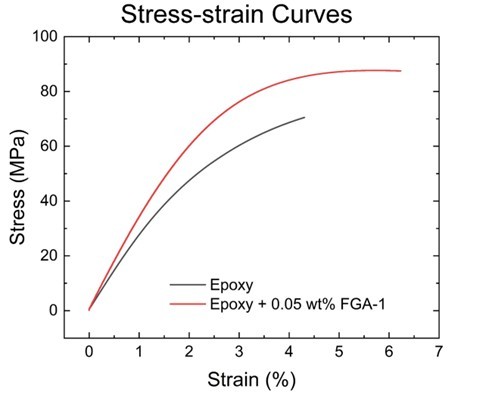
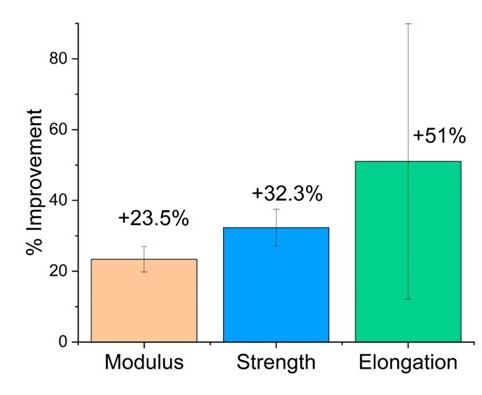
HydroGraph’s Pristine Turbostratic Graphene in Action
Increase in Stiffness, Strength, and Toughness in Epoxy Resin
See how HydroGraph provides the purest, most consistent, cost-effective graphene solution.
We use cookies to ensure that we give you the best experience on our website. If you continue to use this site we will assume that you are happy with it.