Graphene Applications for Stronger, More Durable, Lightweight Components
Graphene compounded into thermoplastics enhances mechanical properties, thermal and electrical conductivity, moisture and gas barrier performance, while maintaining or improving processability.
MARKET OVERVIEW
The thermoplastic industry encompasses a wide range of polymer materials that can be repeatedly melted and reformed, including polyethylene (PE), polypropylene (PP), polystyrene (PS), acrylonitrile butadiene styrene (ABS), polyvinyl chloride (PVC), polyethylene terephthalate (PET), and engineering plastics like polyamide/nylon (PA), polycarbonate (PC), and polyetheretherketone (PEEK).
$650 BILLION MARKET SIZE
Compounding plastics involves blending these base polymers with additives, fillers, reinforcements, and modifiers to enhance specific properties and create customized materials for targeted applications. These versatile materials are converted through a variety of melt processes including injection molding, profile and sheet extrusion, fiber spinning, blow molding, rotomolding, thermoforming, 3D printing, to create products with specific performance characteristics tailored to demanding applications.
The thermoplastic industry serves diverse sectors and applications, including:
Automotive Components
Electronics and Electrical
Packaging and Consumer Goods
Medical and Healthcare
Construction and Building
Aerospace and Defense
Industrial Equipment
Features and Benefits of Thermoplastic Compounds with Graphene
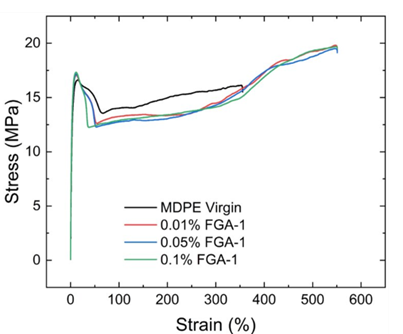
Significantly improves strength, modulus, toughness, and impact strength, increasing plastic performance by 20% to 100% while maintaining processability.
Provides tunable electrical properties from anti-static to conductive, enabling EMI shielding, static dissipation, and smart material applications in electronics and automotive sectors.
Reduces thermal expansion and shrinkage during processing, resulting in improved dimensional accuracy and reduced warping in precision-molded components.
Enhanced friction reduction, scratch resistance, and abrasion durability enable longer-lasting surfaces while preserving the aesthetic qualities required for consumer and automotive applications.
Maintains excellent melt flow characteristics and processability, allowing for standard thermoplastic processing equipment without significant modifications.
Enables lightweighting and material reduction while maintaining or improving performance, contributing to lower carbon footprint and reduced material costs.
HydroGraph’s Pristine Turbostratic Graphene in Action
30% Increase in Strength at Break
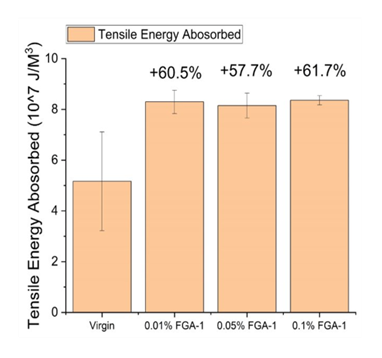
60% Increase in Toughness
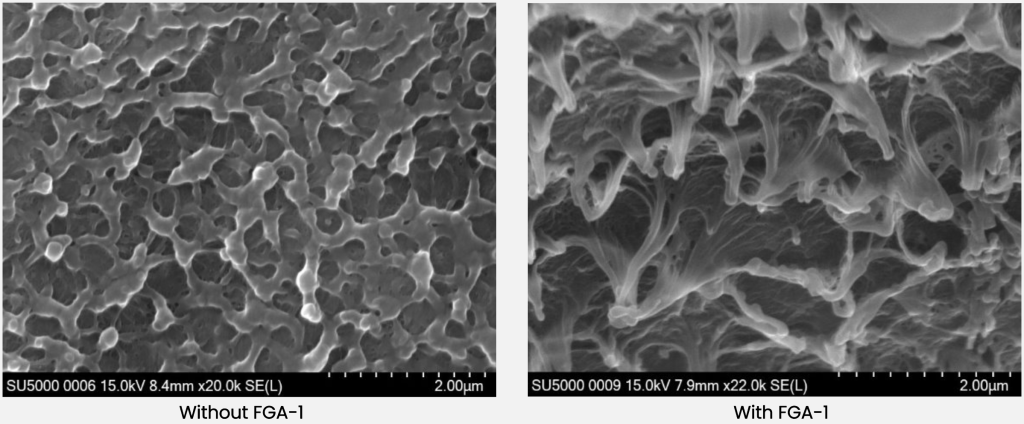
Enhanced Fracture Resistance
See how HydroGraph provides the purest, most consistent, cost-effective graphene solution for thermoplastic applications.
We use cookies to ensure that we give you the best experience on our website. If you continue to use this site we will assume that you are happy with it.