

One-step synthesis of graphene via catalyst-free gas-phase hydrocarbon detonation
A one-step, gas-phase, catalyst-free detonation of hydrocarbon (C2H2) method was developed to produce gram quantities of pristine graphene nanosheets (GNs). The method allows for the control of the number of layers, shape and size of the graphene nanosheets. The process can be scaled up for industrial production.

Aerosol Gelation: Synthesis of a Novel, Lightweight, High Specific Surface Area Material
We demonstrate that an aerosol can gel. This gelation is then used for a one-step method to produce an ultralow density porous carbon material. This material is named an aerosol gel because it is made via gelation of particles in the aerosol phase.
Synthesis of Silica Aerosol Gels via Controlled Detonation
Silica (SiO2) aerosol gels were formed via Brownian aggregation of silica nanoparticles in a closed reaction chamber. A sudden and quick detonation reaction of pyrophoric silane (SiH4) with either oxygen or nitrous oxide created silica nanoparticles with diameters ranging from ∼22 to 90 nm in the presence of an inert background gas with a volume fraction of ca. 10−4, conditions necessary for gelation.

Highly oxidized graphene nanosheets via the oxidization of detonation carbon
A unique approach was developed to produce highly oxygenated graphene nanosheets (OGNs) by solution-based oxidation of the pristine graphene nanosheets (GNs) prepared via a controlled detonation of acetylene with oxygen. The produced OGNs are about 250 nm in size and are hydrophilic in nature.

Synthesis of turbostratic nanoscale graphene via chamber detonation of oxygen/acetylene mixtures
A study of the detonation synthesis method to make graphene and the properties of the resulting graphene is presented. The gaseous precursors are mixtures of oxygen and acetylene with oxygen/carbon molar ratios of O/C = 0.25 to 0.75. Chamber pressure and temperature data indicate pressures ≤ 300 psi and temperatures of 2550 ± 100K after initiation of the reaction mixture.

Ultrafast Transient Absorption Spectroscopy of Inkjet-Printed Graphene and Aerosol Gel Graphene Films: Effect of Oxygen and Morphology on Carrier Relaxation Dynamics
The tunable electronic properties of nanostructured graphene make it one of the most sought alternatives to metals for novel technological applications. In particular, the ability to prepare inks out of these nanostructures allows for printable and thus scalable graphene-based electronics.

Thermoset/graphene polymer composites—A review of processing and properties
Polymer-carbon nanocomposites incorporate the exceptional properties of both the polymer matrices, such as low cost and simple processing, with the distinctive features of the carbon-based fillers, such as high electrical and thermal conductivities, and excellent mechanical properties.

Incorporation of Novel Graphene Nanosheet Materials as Cathode Catalysts in Li–O2 Battery
This study reports the superior performance of graphene nanosheet (GNS) materials over Vulcan XC incorporated as a cathode catalyst in Li–O2 battery. The GNSs employed were synthesized from a novel, eco-friendly, and cost-effective technique involving chamber detonation of oxygen (O2) and acetylene (C2H2) precursors.

Graphene nanosheets from the controlled explosion of aromatic hydrocarbons
Explosions of benzene, toluene and xylenes were carried out in a 16.7 L chamber in the presence of O2 at different fuel-rich molar ratios such that an aerosol of elemental carbon was produced. The product was a powder at higher precursor oxygen content and an aerosol gel at lower oxygen where the carbon yield was larger.
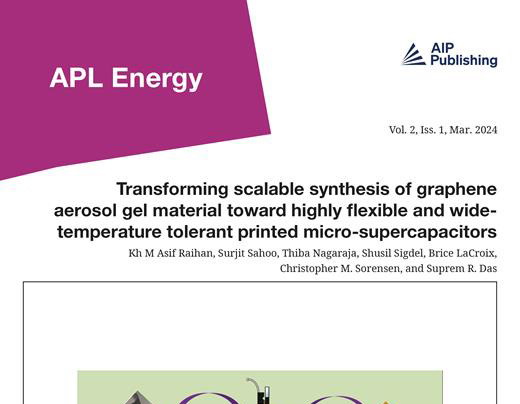
Transforming scalable synthesis of graphene aerosol gel material toward highly flexible and wide-temperature tolerant printed micro-supercapacitors
The ever-growing demand for portable, bendable, twistable, and wearable microelectronics operating in a wide temperature range has stimulated an immense interest in the development of solid-state flexible energy storage devices using scalable fabrication technology.

Description of an activity-based enzyme biosensor for lung cancer detection
Lung cancer is responsible for more deaths worldwide than all other cancers. This report describes a panel of 18 sensors that release a fluorescent signal when these enzymes are present in a blood sample. The signal acts like a fingerprint of activity that can be used to identify people with lung cancer.

New Generation Graphenes in Cement-Based Materials: Production, Property Enhancement, and Life Cycle Analysis
This paper discusses the use of two novel graphene types, fractal graphene (FG) and reactive graphene (RG), obtained through a cost-effective and scalable detonation synthesis, in cement-based materials.

Rheology and early-age structure development in binary and ternary blends modified with novel graphene types
This study explores the influence of novel, cost-effective, environment-friendly, and massproducible graphene on the rheology and early-age structure development of cementitious binders.

Enhanced performance of a supercapacitor by addition of turbostratic Fractal Graphene to an activated carbon electrode
This research explores the enhancement of supercapacitor performance through the incorporation of a new form of turbostratic graphene (Fractal Graphene, FGA-1) into activated carbon (AC) electrodes.
Oxygenated graphene ink coatings for efficient heat dissipation
Cost-effective thermal management coatings are essential for next-generation microelectronics, where rising heat fluxes demand innovative surface engineering. This study demonstrates that graphene-based coatings, engineered via scalable aerosol deposition, can dramatically enhance pool boiling heat transfer by leveraging surface morphology rather than relying solely on bulk thermal conductivity.

Microstructure densification in cement pastes enabled by novel graphene types
The primary barriers hindering graphene’s widespread adoption as a performance-enhancing additive in cement based systems have traditionally been its prohibitive cost and the sustainability concerns associated with conventional manufacturing processes. This paper explores the influence of ultra-low dosages of FG and RG (≤ 0.04 % by mass of cement, which results in ~20 % increase in compressive strengths) on the pore-structure features of cement pastes.
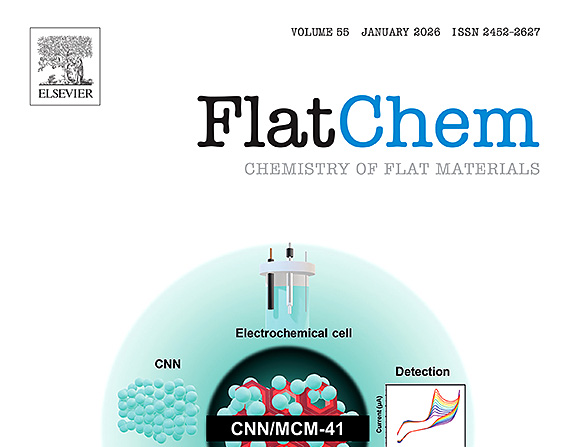
Adsorption-based removal of organic dyes via a sustainably produced few-layered graphene: A potential method for industrial wastewater treatment
This study discusses adsorption-based removal of six chemically distinctive organic dyes using graphene produced via a chamber explosion method. The method of graphene synthesis is sustainable as it produces zero waste, requires low energy and is scalable. The dye removal was investigated via UV–visible spectroscopy and proved to be efficient, with near-complete removal of all dyes within 10 min of adsorption by graphene.
Chamber explosion synthesis of fractal aggregate graphene
This paper provides a comprehensive review of the nanoscale, fractal aggregate graphene produced by HydroGraph Clean Power, Inc. The chemistry of the chamber explosion synthesis and the subsequent physics of the fractal aggregation are explained. This is followed by a description of the physical properties of the resulting fractal graphene aggregate (FGA).