
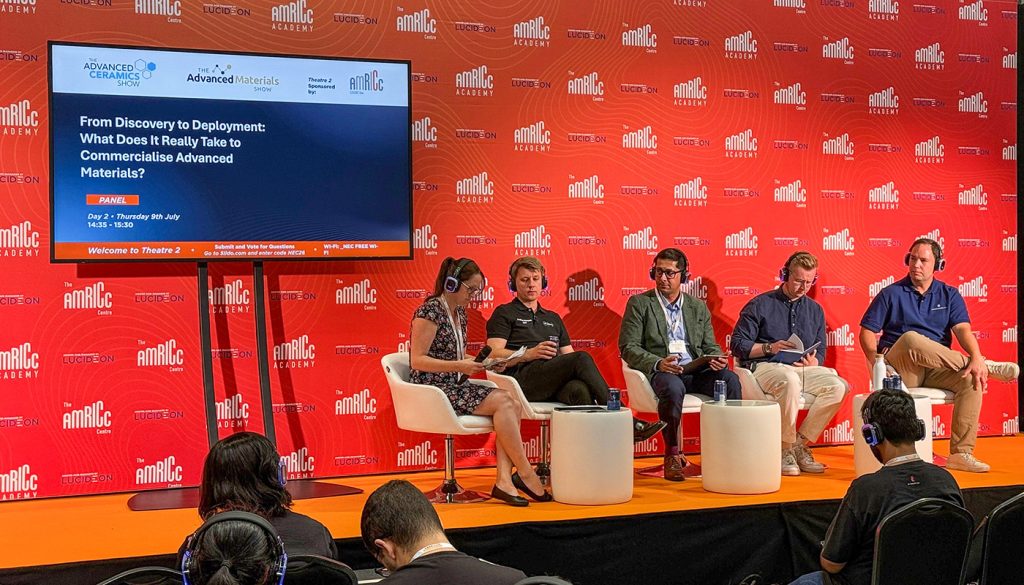
Manchester, UK — Advanced Materials Show
At this year’s Advanced Materials Show, HydroGraph joined a panel exploring what it really takes to move materials from lab discovery to industrial deployment. The session brought together a rare cross-section of the materials value chain. From an Imperial College spin-out to a commercial graphene producer to two multinational end-users with the power to actually put new materials into products.
Moderated by Lisa Scullion, Engineering Director at the Graphene Engineering Innovation Centre (GEIC) in Manchester, the panel included Tom Eldridge, HydroGraph’s Director of Business Development, Dr. Andrius Patapas (CEO of 2D Nano), Dr. Mandar Thakare (BP), and Gary Martin (BAE Systems). Representing HydroGraph, Tom brought the producer’s-eye view to a wide-ranging discussion on scale-up economics, credibility, supply chain trust, and what it will take to pull advanced materials out of the so-called “Valley of Death” between lab and industry.
The themes that ran through the room
Even before individual perspectives diverged, a handful of themes surfaced again and again across the panel as a whole.
Lab-scale performance doesn’t always survive scale-up unchanged. Headline figures of 100%, 200%, 300% improvements often cited in the literature can look very different by the time a material reaches industrial application. Panelists agreed that understanding why a material performs the way it does at lab scale is exactly what allows producers to protect and validate that performance as they scale; the real differentiator is doing that translation work well, not the fact that translation is needed at all.
Credibility is earned with data, not decks. Panelists agreed that risk-averse industrial buyers respond best to relevant, application-specific evidence rather than broad performance claims. Including a shared observation that even a slick, AI-assisted pitch deck can’t substitute for real application data.
Safety and end-of-life questions are foundational, not optional. Certification, leaching, recycling, and regulatory approval came up as baseline requirements for onboarding any new material.
Commercialization is a team sport. There was a shared sense that no single company gets a material from lab to industry alone. It takes collaboration across the supply chain.
Adopters want the problem first, not the pitch. From the buyer’s side of the table, panelists stressed the importance of understanding timescales, process, and interdependency. Starting from the customer’s problem rather than a solution looking for a use case. They flagged early sample availability, at fair commercial rates, as a practical way to help validate data before bigger commitments are made.
Materials are a different game than software
Asked what the single biggest challenge is in turning advanced materials into industrial impact, Tom framed his answer around a core requirement for any new technology to gain traction: it has to fulfil a role, and do that job better than the alternatives already on the market. Materials, he argued, add a layer of complexity that few other technology categories share.
Unlike software for instance, where the product can be engineered with the end-customer or market from the start, which can be iterated and tested with customers cheaply and quickly, materials development usually starts with an invention or discovery in hand rather than a problem in mind, with longer and more costly development and testing cycles.
The real work is translating a material with impressive properties into a specific place where it will actually be used.
He also flagged that graphene itself isn’t a single, interchangeable product: every producer’s material is different, so trends and case studies from one graphene don’t necessarily transfer to another. That means each producer has to build and prove its own value proposition separately, rather than riding on the industry’s collective momentum. A genuine hurdle, but one that also means real differentiation, once proven, becomes a durable edge rather than something easily copied.
Because capital costs are higher and timelines longer than in other tech sectors, getting to genuine product-market fit efficiently without wasted cycles chasing the wrong application becomes the central task. This is precisely the work HydroGraph has focused its applications development around, generating application data that proves a real customer problem is being solved better than by any existing alternative.
“It’s kind of no good leaving it up to the customer to work out how to successfully integrate your material. You’ve got to take the bull by the horns and put the investment in to figure it out.”
That’s what makes finding the right “beachhead application” so critical and why it falls to the material producer, not the customer, to generate that compelling application data. Where that work doesn’t happen, Tom noted, materials can end up in a kind of “no man’s land” between production and application, which is exactly why HydroGraph built out its own applications development capability at the GEIC, to close that gap rather than leave it to customers.
That doesn’t always mean going it alone, though. Tom noted that closing this gap often calls for complementary innovations and outside partners: sometimes a producer can build the case itself, but just as often it means bringing in others with the right expertise to get a material across the line.
From an accidental discovery to a business opportunity
Scullion put the question directly to Tom: at what point did the science become a business opportunity? He traced HydroGraph’s answer back to an accidental discovery in the lab by the company’s co-founder, Professor Chris Sorensen. An experiment in carbon-based aerosol gels that turned out to produce ultra-high-purity, few-layer graphene with an unusually low energy footprint.
He pointed to two milestones that turned that discovery into a commercial opportunity, proof points that HydroGraph had cleared the hardest parts of the scale-up curve described elsewhere in the session: reaching ton-scale production with ISO 9001 accreditation, a threshold some customers simply won’t engage below, and more recently, establishing an applications development base at the GEIC in Manchester.
That work revealed something unexpected: HydroGraph’s graphene, with its distinctive morphology and a particle size far smaller than the high-aspect-ratio material typically discussed in the literature, could outperform conventional graphene nanocomposites at lower concentrations than expected, opening up applications that hadn’t previously been economically viable for the graphene industry.
Those results, Tom said, are what let HydroGraph see the real business opportunity and interest in the company has been building ever since, growing directly out of that same underlying data rather than just a broader industry trend.
Advice for early-stage companies: talk to customers first
Turning to advice for early-stage companies, Tom cautioned against a common pitfall: investing too heavily in sales and marketing before genuinely engaging customers.
“Don’t assume you know what you’re doing without actually talking to the right people.”
Market research alone isn’t a substitute for real customer discovery. Understanding recurring pain points, existing alternatives, and what “good” looks like to the buyer, before scaling a commercial organization around assumptions. It’s an iterative, hypothesis-driven process not unlike lab research itself: forming a belief about product-market fit, doing enough testing to bring something credible to an industry partner, and then building out more rigorous validation collaboratively.
What would accelerate adoption? Two-way education.
Closing the session, Tom was asked what single change would most accelerate industrial adoption of graphene and advanced materials. The answer centered on deeper, earlier engagement between graphene producers and target industries.
“There’s a lot of education that has to happen from graphene providers to companies that maybe never even heard of it. But it also needs to come the other way. Companies need to better understand what industry is looking for before we go to them with a proposed solution.”
That kind of exchange, Tom noted, is already picking up. HydroGraph’s applications work now spans verticals from coatings and composites to concrete and energy storage. Each one representing a target industry the company has engaged more deeply as understanding builds in both directions.
Interested in working with us?
HydroGraph’s Fractal Graphene Aggregate is being developed and validated across coatings, composites, concrete, and energy storage applications with partners including the GEIC in Manchester. If you’re exploring where graphene could solve a problem in your industry, get in touch with our business development team or reach out about sample availability to start your own validation work.